As a convicted felon, Trump can still run for the presidency. He is expected to appeal the conviction. Here’s what you need to know.
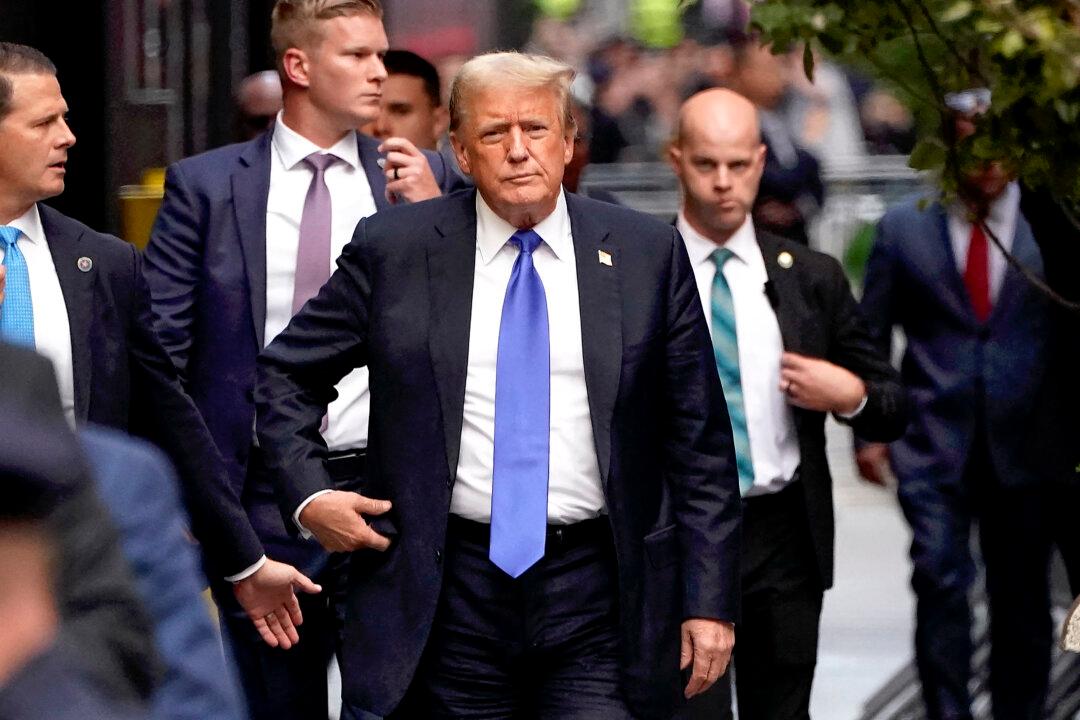
Former President and Republican presidential candidate Donald Trump arrives back at Trump Tower after being convicted in his criminal trial in New York on May 30, 2024. (Timothy A. Clary/AFP via Getty Images)
A Manhattan jury took fewer than 12 hours to return a verdict in former President Donald Trump’s New York criminal trial, finding him guilty of 34 counts of falsification of business records with the intent to conceal another crime.
The former president’s conviction makes him the first U.S. president to be convicted of a crime.
Short of a successful appeal, he could now be facing such penalties as jail time, probation, or fines.
Ultimately, it will be up to the presiding judge, Justice Juan Merchan, to decide on the appropriate sentence. Manhattan District Attorney Alvin Bragg has not indicted if prosecutors will seek prison time.
The judge has set the sentencing hearing for July 11 at 10 a.m. This is four days before the Republican National Convention where President Trump will be formally designated as GOP presidential nominee.
As a convicted felon, President Trump is not barred from running for the White House.
Crimes
The six-week trial revolved around $130,000 in payments that President Trump’s former attorney, Michael Cohen, paid adult film actress Stormy Daniels, whose real name is Stephanie Clifford, ahead of the 2016 presidential election.
Manhattan District Attorney Alvin Bragg claimed that Mr. Cohen made the payments on President Trump’s behalf to buy Ms. Clifford’s silence over an alleged affair that the former president denies took place. The district attorney further charged that President Trump mislabeled his reimbursements to Mr. Cohen for those payments to conceal another crime, constituting felony-level falsification of business records.
Prosecutors alleged that the secondary crime is a New York election law that criminalizes conspiracy “to promote or prevent the election of any person to a public office by unlawful means.”
The unlawful means identified by prosecutors were violations of the Federal Election Campaign Act, the falsification of other business records, or violations of tax laws. Judge Merchan ruled that the jury did not have to unanimously agree on what the “unlawful means” was.
Throughout the trial, President Trump maintained his innocence of any crimes.
What’s Next?
The crimes President Trump was convicted of are class E felonies, the lowest level under New York law. Each count carries a maximum sentence of four years in prison, but state law limits the total maximum sentence to 20 years.
President Trump is likely to immediately appeal his conviction, and he has 30 days to do so. But should that effort fail, his fate will rest in the hands of a judge he has vocally criticized as biased and “corrupt.”
During the trial, the former president twice sought Justice Merchan’s recusal over perceived conflicts of interest. One of those alleged conflicts was the fact that the judge’s daughter, Loren Merchan, heads up a political consulting firm that boasts the Biden-Harris campaign as a client.
Justice Merchan also imposed a gag order on President Trump, preventing him from commenting on court staff, prosecutors, potential witnesses, jurors, and members of the judge’s own family. During the trial, President Trump was fined $9,000 for violating the gag order.
Many legal experts
do not expect President Trump to face jail time. Mr. Bragg speaking after the verdict on May 30 did not answer questions about whether prosecutors were seeking a prison sentence.
Other than prison, probation or home confinement are also options.
The sentencing decision will be up to the discretion of Judge Merchan, who will take into account President Trump’s criminal record—he has no prior history—and other factors, like his personal history and the crimes itself.
It’s also possible the judge would allow Trump to avoid serving any punishment until after he exhausts his appeals.
Calling the trial a “disgrace,” the former president appeared undeterred by the verdict as he addressed reporters outside the courtroom.
“The real verdict is going to be Nov. 5, by the people,” he said, adding, “We’ll keep fighting, we’ll fight to the end, and we’ll win.”
Can Trump Still Run for President?
Yes. Even as a convicted felon, President Trump can continue his campaign to return to the White House. There is nothing in the Constitution prohibiting a convict from running for or serving in America’s highest office.
Just four days after the scheduled sentencing hearing, the Republican National Committee is set to nominate President Trump as the party’s presidential candidate during a convention starting July 15.
The only way someone cannot run for president—besides not being born in the United States or not being born to a parent who is already a U.S. citizen, is under the age of 35, and has not been a 14-year resident in the United States—is if the Senate votes to bar the person from running for future office. But that vote, which only requires a simple majority, cannot occur unless the person is convicted in an impeachment trial—which requires a two-thirds majority; the House does the impeaching.
On top of his conviction in New York, President Trump also remains embroiled in two federal cases brought by special counsel Jack Smith and a 2020 election case in Georgia brought by Fulton County District Attorney Fani Willis.
His mounting legal woes have posed an obstacle to his presidential bid. With the first presidential debate coming up on June 27, the presumptive GOP nominee would undoubtedly prefer to be campaigning rather than fighting for his freedom.
Can Trump Be President If He’s in Jail?
Even if President Trump is sentenced to prison before the election, he can still serve as commander-in-chief should he be elected. He would still be able to order military action, sign bills into law, grant clemency in federal cases, sign proclamations, and fulfill all the responsibilities of the president.
What the presidential office setup in jail or prison would look like is a separate matter. But he still would have Secret Service protection like any president. Even as a former president, he has Secret Service protection unless he were to decline it—which, given the threats against him, is highly unlikely.
Can Trump Pardon Himself?
Were President Trump to win in November, he would still be unable to pardon himself given that the president can only grant clemency related to federal cases. While he could pardon himself if he is convicted in his two federal cases, the trial in New York was a state case. There, the only one who can pardon him is the governor of The Empire State.
Given that New York Gov. Kathy Hochul is a Democrat critical of the former president, it appears unlikely she will pardon him.
Brethren – God’s will be done. He already knows how this will play out. WE MUST TRUST HIM!!
MARANATHA!


